
|
I had been looking forward to visiting Echuca for a while because it’s the site of one of the greatest of Australia’s invisible faith stories. Back in the 1870’s Daniel and Janet Matthews, without support from any church or society, created a sanctuary for the suffering and hunted Aboriginal people. They called it Maloga.
Located on a beautiful bend of the Murray River, this traditional ceremonial ground saw leaders emerge from the Yorta Yorta people who learned to make the teachings of Jesus a launching pad for the civil rights movement that finally gave them recognition as citizens in their own country.
0 Comments
Cummeragunja sits on a sweeping bend of the Murray River about 20km upstream from Echuca. It’s home to some significant chapters of the Christian experience of the Yorta Yorta people. I’ve already posted the story of the remarkable Thomas Shadrach James, who taught a generation of Aboriginal activists to ‘lead and write.’ It was good to stand in the schoolroom of that dedicated Mauritian Indian teacher who quietly helped change the course of history for the Aboriginal people. Two of his trainees - Doug and Gladys Nicholls - are buried side by side out on the sand ridge and it was an honour to pay our respects there to these two outstanding Australians. I’ve told their story on this Outback Historian website. I think these people made Cummeragunja a genuinely sacred site. Look out for more stories related to this place.
In December 2007, a crowd of 500 people outside Victoria’s Parliament building gave a lengthy applause as of one of Australia’s most unusual statues was unveiled. The bronze figures of a husband and wife stand arm in arm – he with a welcoming smile, an open stance and a hand extended – she, erect beside her man, looking at him with an expression of love and pride.
Sculptor Louis Lamen had gifted Australia with a warm and lasting image of one of the most unique teams in its history. A journalist dubbed them ‘a compelling double act’ and he was right – they were! The memorial describes them as, ‘River People who turned the tide of history and injustice to progress the rights of Aboriginal and Torres Strait Islander peoples. This is the first memorial statue in Melbourne dedicated to two Aboriginal community leaders, Pastor Sir Doug and Lady Gladys Nicholls. They vigorously fought for the rights of Aboriginal and Torres Strait Islander peoples across this country and are an eternal symbol of our ongoing history and commitment to human rights in Australia.’ This is the story of a humble teacher who turned a wooden building on the Murray River into a kind of bush university – one that grew leaders who changed Australia. Thomas Shadrach James, was born in 1859 in Mauritius, an island off the coast of Africa known for its diverse racial make-up, mixed cultures and variety of religious faith. His parents were poor people determined to educate their children. His father worked his way from being an indentured labourer to serving as an interpreter for the British colonial government and a teacher in the Anglican Church. So, it’s no surprise that at the age of fourteen, Thomas was tutoring other boys and fluent in French, English and Tamil.
Discouraging family events drove 20-year-old Thomas to leave home to seek his fortune alone in Australia. His obvious ability saw him enrolled in medicine at Melbourne University in 1880, but a bout of typhus left him with shaking hands. The new immigrant made a disconsolate figure walking Brighton Beach on Port Phillip Bay on January 3rd 1881, his aspiration to be a surgeon shattered. READ MORE ... This photo tells a story.
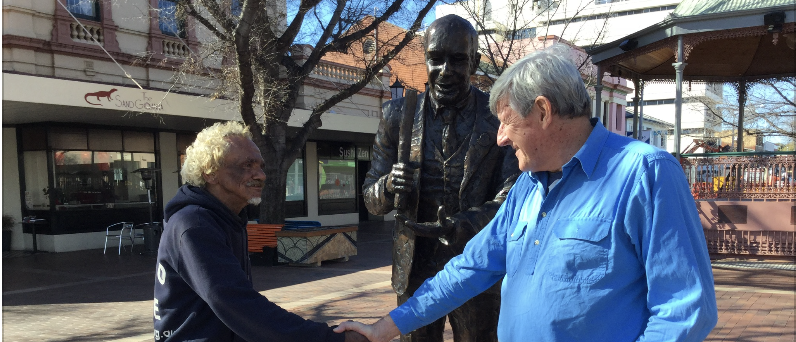
This week my son Chris presented Riverbank Frank Doolan with an artwork he’s done of Bill Ferguson – he’s the bronze figure in the picture. The painting is Chris’s version of the famous photo taken of Bill standing in Elizabeth street in Sydney on Australia Day 1938 with a group of supporters. His quiet but forceful protest called attention to the sad fact that the Aboriginal peoples of our country were yet to be recognised as citizens. There are other stories hidden behind this photo. READ MORE ... Aunty Pat Doolan is one of those rare people you meet in life who radiate goodness. As a result she’s been a game-changer wherever she’s lived. You can’t help being touched by her rare blend of determination and kindness - that’s how she’s got things done. She leads by being a servant and she never wavers in declaring her faith in public.
‘We need to share our stories, accept our stories, and write a new story together.’ - Billy Williams.
In recent years, the story of Bill Ferguson has been highlighted in the main street of Dubbo. While Martin Luther King and his 'I have a dream' speech is well known, Bill Ferguson and William Cooper and others who played similar roles on behalf of the Aboriginal people, are not. Paul and Riverbank Frank take as many opportunities as they can to tell the Bill Ferguson story in schools and groups of young people. Paul wrote this short story after speaking with Bill Ferguson's daughter Isabel. 'A curtain of steady late-winter rain swathes the evening sky. Dwarfed by the leaden expanse of cloud, three figures plod steadily along the sodden roadway, picking their way through the puddles. The man is a tall, erect figure, his muscular shoulders filling out his dark suit coat, water streams from the Fedora hat pulled firmly down over his eyes. The stripling boy struggles manfully with the battered suitcase, now and then swapping it from hand to hand, while his sister strides alongside her father, head held high, hair bedraggled, clutching a parcel of food wrapped in grease-proof paper. ( Read the rest by clicking on Read More.) |
AuthorJoin The Outback Historian, Paul Roe, on an unforgettable journey into Australia's Past as he follows the footprints of the Master Storyteller and uncovers unknown treasures of the nation. Archives
February 2026
Categories
All
|
RSS Feed